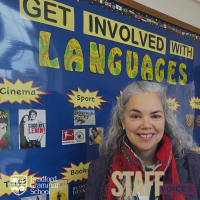
Elizabeth Kingsley, Head of Modern Languages at Bradford Grammar School, explains why languages remain central to a strong academic education — from early immersion and cultural literacy to subject depth and real-world impact.
One of the things I feel most strongly about at Bradford Grammar School (BGS) is that languages matter – academically, culturally and personally. They are central to how we educate young people to understand the world beyond their immediate experience and to engage with it confidently.
Languages at BGS are strong because they are valued. Every student studies at least one language to GCSE, and many continue with two. That commitment sends a clear message: languages are intellectually rigorous, they develop powerful transferable skills and they belong alongside sciences, humanities and the arts at the heart of a strong and rounded academic education. At a time when languages nationally are in decline, we are bucking the trend, with healthy uptake at A level and students choosing to study languages alongside STEM subjects, medicine, law and economics because they can see the advantage it gives them.
Our department is large, expert and genuinely collegiate. There are twelve of us, including permanent language assistants and native speakers of French, German and Spanish, which allows students to hear authentic voices and accents every day. I believe the language teacher is the greatest resource in the classroom and that’s why every member of the department is a subject specialist, deeply knowledgeable about their language and its culture.
What we teach is far more than vocabulary and grammar. Culture is a fundamental part of language learning, particularly at GCSE and A level. Students study festivals, traditions and everyday life, but also engage seriously with politics, history and society. At A level, lessons are largely taught in the target language and students are expected to form and express opinions on a gripping range of topics such as immigration, crime, youth culture, the rise of the far right in France, dictatorships in Spain or East–West relations in Germany. They study film and literature, analyse current affairs and learn to argue their case with precision and nuance. It is demanding, but it is also what makes languages such a powerful academic discipline.
Technology has transformed how we teach. When I started teaching, lessons were very much “chalk and talk”, with grammar books and sentence translation. Now, students have access to live and authentic materials at the click of a button. We have dedicated computer suites for languages, so if a student wants to hear what President Macron has said on a particular issue, they can watch and listen to it directly. Students benefit enormously from hearing real voices and seeing language used in context.
That emphasis on engagement begins early. In Clock House, children are introduced to French and German in Reception and Year 1, learning sounds and phonics alongside English. At that age, they are natural mimics and absorb pronunciation instinctively through songs, games and repetition, often without realising they are learning. Starting young builds confidence and accuracy, and it pays dividends later. By Year 7, all students learn French and German, and in Year 8 they choose two from French, German and Spanish. Many continue with two languages through to GCSE, finding that the skills reinforce each other.
We are also proud of the way we support community and enrichment languages. Each year, we see students pursue qualifications in languages they already speak at home. Recently, students have taken GCSEs and A levels in languages such as Russian and Chinese, alongside enrichment opportunities in languages including Japanese. Bradford is a richly multilingual city, and many of our students are bilingual or trilingual, adept at code-switching — moving fluently between languages — and thinking across languages. That linguistic agility is a real strength, and we work hard to recognise and support it.
Trips remain a vital part of language learning at BGS. There is no substitute for being in the country, hearing the language spoken around you and realising that you can communicate. Students in all three languages take part in overseas trips during Key Stage 3, giving those in Years 7, 8 and 9 early exposure to language and culture beyond the classroom. For A Level students, subject-specific trips are invaluable. Visiting Berlin to see the sites studied on the specification – the Stasi headquarters and remains of the Berlin Wall – brings history, politics and language together in a way no textbook can.
Languages at BGS are outward-looking and collaborative. We celebrate the European Day of Languages each year, run cultural activities such as French cookery lessons taught entirely in the target language and take part in national competitions, including the GCHQ code-breaking challenge, which highlights the links between languages, computer science and analytical thinking. Our Sixth Formers also plan and deliver French lessons in local primary schools – an experience that develops leadership, confidence and communication skills.
This academic confidence extends beyond the classroom. In February, A level students will take part in the Modern Foreign Languages Debating Competition at St Peter’s School, debating topical motions in French, German and Spanish alongside peers from across the region. The event develops not only linguistic fluency, but the ability to think on the spot, argue persuasively and engage with complex ideas.
My own route into languages was shaped by travel and exchange, and by the realisation that language is ultimately about people. I studied French and German at university, spent time living and working abroad, where I learned Spanish, and later trained in translation and interpreting before returning to teaching, certain that the classroom was where I belonged.
Having joined BGS in 1998, progressing to Head of French before becoming Head of Modern Languages, I have seen the department evolve while remaining rooted in academic depth, cultural understanding and high expectations. It remains a privilege to see students discover how languages open doors. Nothing is more rewarding than hearing from Old Bradfordians who tell us that languages gave them an edge, whether working in medicine abroad, business, international policy or the charity sector.
Languages teach students to think carefully, communicate clearly and understand others. In an increasingly globalised world, those skills have never been more important.
“Languages teach students to think carefully, communicate clearly and understand others. In an increasingly globalised world, those skills have never been more important.”