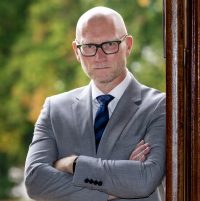
As he marks ten years at Bradford Grammar School, Headmaster Dr Simon Hinchliffe reflects on the ideas and values that have shaped his leadership — from Hoc Age and hard work to kindness, trust and community. In conversation with Bradford Grammar, he looks beyond milestones and metrics to consider what makes the school thrive.
Ten years into his time at Bradford Grammar School, Dr Simon Hinchliffe is wary of easy narratives.
He is not especially interested in anniversaries, still less in tidy stories about progress neatly plotted over time. What matters to him is substance: the daily work of a school, the people within it and the culture that quietly shapes everything else.
“Education is not a zero-sum game,” he says. “You can have it all.”
It’s a line that captures much about his leadership. Over the past decade, Bradford Grammar School has strengthened academic outcomes while developing pastoral programmes, widening participation across sport, music, public benefit and wider enrichment. “If you look at the performance metrics,” Dr Hinchliffe says, “the needles are green.” What he resists is the idea that progress requires an overly prescriptive, autocratic version of schooling.
“The zero-sum thinking makes you believe that to improve tangible, measurable outcomes you have to sacrifice kindness, compassion and inclusivity,” he says. “I don’t believe that. All the balls can be rolled up the hill at the same time if you act with purpose and align around shared values.”
That philosophy — ambitious but humane, rigorous but relational — has become embedded in the life of the school. And it did not arrive with a grand announcement. Dr Hinchliffe’s first day as Headmaster at BGS, ten years ago this month, was anything but polished. Introduced to staff immediately after the delivery of some unwelcome news, he stood up, said hello, stepped out of the limelight and then got on with meeting people.
“What stayed with me wasn’t the challenging nature that moment. It was the warmth and humanity,” he reflects. “People taking the time to talk. A cup of coffee brought into my office at the end of the day. Those small moments of honest connection told me I’d landed in a good place.”
They also set the tone for how he would lead.
Rather than imposing change from a distance, Dr Hinchliffe spent his earliest days listening — learning the fine grain of the school, its rhythms and relationships. A brief spell as deputy head placed him firmly “in the bowls of the machine”, as he puts it, sleeves rolled up, attending to detail.
“So, when I became head, there were no excuses. I knew where the potential was, I knew where the challenges were, and the governors quite rightly said: now crack on,” he smiles.
That insistence on substance over show would become a defining feature of his headship. One of the earliest and most visible examples came in the form of something deceptively simple – the school’s identity.
“When I arrived, the school didn’t appear to me to cohere around a central purpose or identity,” he recalls. Multiple logos circulated, communications sometimes lacked consistency, and, for some, even the school motto felt oddly detached from their daily lives. “I asked pupils what Hoc Age meant,” he says. “Significant numbers couldn’t tell me.”
The decision to act was swift and, by his own admission, risky. “You change a school crest, for example, and you’re into potentially career-ending territory,” he says, half joking. But the aim was never cosmetic. The refreshed identity drew on the school’s heraldic past while giving it coherence, clarity and confidence — one visual language, one sense of purpose, extending from publications to classrooms.
“It wasn’t about branding for branding’s sake,” he explains. “It was about alignment — making sure what we said we valued actually showed up in how the school looked, spoke and behaved.”
Not everyone welcomed the changes immediately. Some worried about tradition, some cherished their particular niche in the wider school landscape. “And that’s understandable,” Dr Hinchliffe says. “But you have to keep making the case for a coherent school community – the school of the present and the future.”
What few people beyond his closest circle appreciated at the time was the personal backdrop to those early decisions. Dr Hinchliffe arrived in Bradford “somewhat on the back foot” he says – relocating from Wolverhampton with his pregnant wife Heidi, moving into rental accommodation, preparing daughter Katy for her first day at school and welcoming a new baby after an emergency hospital visit during the house move.
“It was bonkers,” he says. “Two house moves, a new job, a new city, a baby, another child starting school… and then being told, not long after starting, that my boss was retiring, and I should consider applying for headship!”
Outwardly, the role demanded calm. Inwardly, Dr Hinchliffe admits “the feet were paddling — and Heidi’s were paddling faster.”
That experience left a mark. “It made me much more conscious of the person behind any position of responsibility,” he reflects. “Everyone has a back story. If someone is struggling or pushing back, it’s worth asking what’s underneath. Often, the motives are good.”
It’s a perspective that has shaped his leadership style, recognising the importance of patience, empathy and listening. “I’m definitely a better listener than I was,” he says. “Not just listening politely, but properly. Listening without needing to agree. Listening without needing to argue.”
There is no single moment Dr Hinchliffe points to as defining his headship. Instead, he talks about accumulation: of conversations, gestures, honesty and time. “It’s the incremental handshakes. The quiet thank-yous. People trusting you with things that are difficult for them to say — and sometimes difficult for you to hear.”
Those interactions, he believes, are the clearest sign that things are moving in the right direction. “The signals come slowly here,” he says. “But when they come, they run deep. They are powerful expressions of community.”
That same belief explains his insistence on visibility. Dr Hinchliffe chooses to do lunchtime duties, attend clubs, drive minibuses and join trips when he can. “This is a family,” he explains. “I like to be present, I genuinely care and I enjoy getting down to the shop floor. Being interested can’t be artificial; students know the difference.”
One of the things that worries him most is what he describes as a widespread misunderstanding of schools like BGS — a narrative, he says, that fuels division.
“There can be a tendency to misrepresent independent schools,” he says. “And what sits underneath that is a much bigger issue — this engineered separation, ‘them and us’ thinking amplified in discrete echo chambers. It’s not just about schools. It’s wider society.”
His response has never been to shout louder. “I’d rather straightforwardly and warmly articulate who we actually are,” he explains. “A diverse and decent community. Part of Bradford, part of Yorkshire, part of the UK. A positive contributor to something bigger than ourselves.”
A glance at the school’s alumni, he argues, tells its own story. “The famous and the not-so-famous. They’re doing extraordinary things — in the arts, sport, science, business, public service, politics. They pack a positive punch.”
Dr Hinchliffe has never subscribed to a rigid career plan. His own life, he says, has unfolded through what he calls “Brownian motion” — movement shaped by opportunity, chance and commitment rather than a prescribed path.
“I fell into teaching without ambition to climb a ladder,” he says. “I just try to give 100 per cent wherever I am.”
That philosophy — grit, graft and openness to possibility — is one he hopes students recognise. Raised in South Yorkshire, he is clear-eyed about effort and purpose, humility and making the most of what’s in front of you.
“If you’re open to surprises and to meeting people you weren’t expecting, life can take you places,” he says. “It is, in many ways, Hoc Age lived rather than stated… don’t waste time or talent, do things properly and give everything you’ve got.”
Read more from Dr Hinchliffe, in his Headmaster’s Blog section.
“This is a family,” he explains. “I like to be present, I genuinely care and I enjoy getting down to the shop floor. Being interested can’t be artificial; students know the difference.”