History

of Bradford Grammar School

Bradford Grammar School History

With an illustrious past stretching back hundreds of years, Bradford Grammar School grew up with Bradford and is one of the oldest schools in Yorkshire and the North of England.

sixth-form-intro-pastoral-care
The story and history of Bradford Grammar School stretch back many centuries and are closely intertwined with the development of Bradford itself.

While the precise date of the school’s foundation is not known, written records show that by the middle of the 1500s the school was already a flourishing institution, supported by land endowments that provided the income needed to run the establishment.

Fast forward a century. In the late 1650s, the governors began lobbying Parliament for a fresh legal basis for the school, and in 1662, King Charles II, soon after his restoration to the throne, issued the school its Charter.

The Charter is a magnificent document and still hangs in the Douglas Hamilton Room, which continues to be used as part of the school today.

Just over two hundred years later, BGS received another significant boost. In 1869, Parliament passed the revolutionary Endowed Schools Act, which transformed the governance and funding of many historic grammar schools across England and Wales.

BGS was the very first school visited by the new Commission established under the Act. The Commission urged the school to modernise its curriculum, expand its numbers, and redevelop its buildings. It also placed a strong emphasis on education for girls.

As a result, a share of the BGS endowment was used to establish Bradford Girls’ Grammar School, which opened in 1875 with 109 girls, a number that rose to more than 400 by 1912.

The next major shift in the school’s life again came from Parliament. In 1944, Churchill’s coalition government passed R. A. Butler’s Education Act, preparing the nation for post‑war peace and opportunity. One of its key provisions was the expansion of government “direct grants”, providing scholarships that enabled more children to attend leading independent schools such as Bradford Grammar School.

The scheme ran for more than thirty years. In the mid‑1970s, the incoming Labour government decided to phase it out and offered schools like BGS the option of joining the state comprehensive system. The governors of BGS declined. The school therefore continued as an independent charitable institution, as it had been for centuries and remains so today.

Our school motto, Hoc Age, can be translated from Latin in more than one way: “Pay attention.” “Action.” “Just do it.”

We like all of them.

Hoc Age captures the energy and drive of the school, and also the history of our great city.

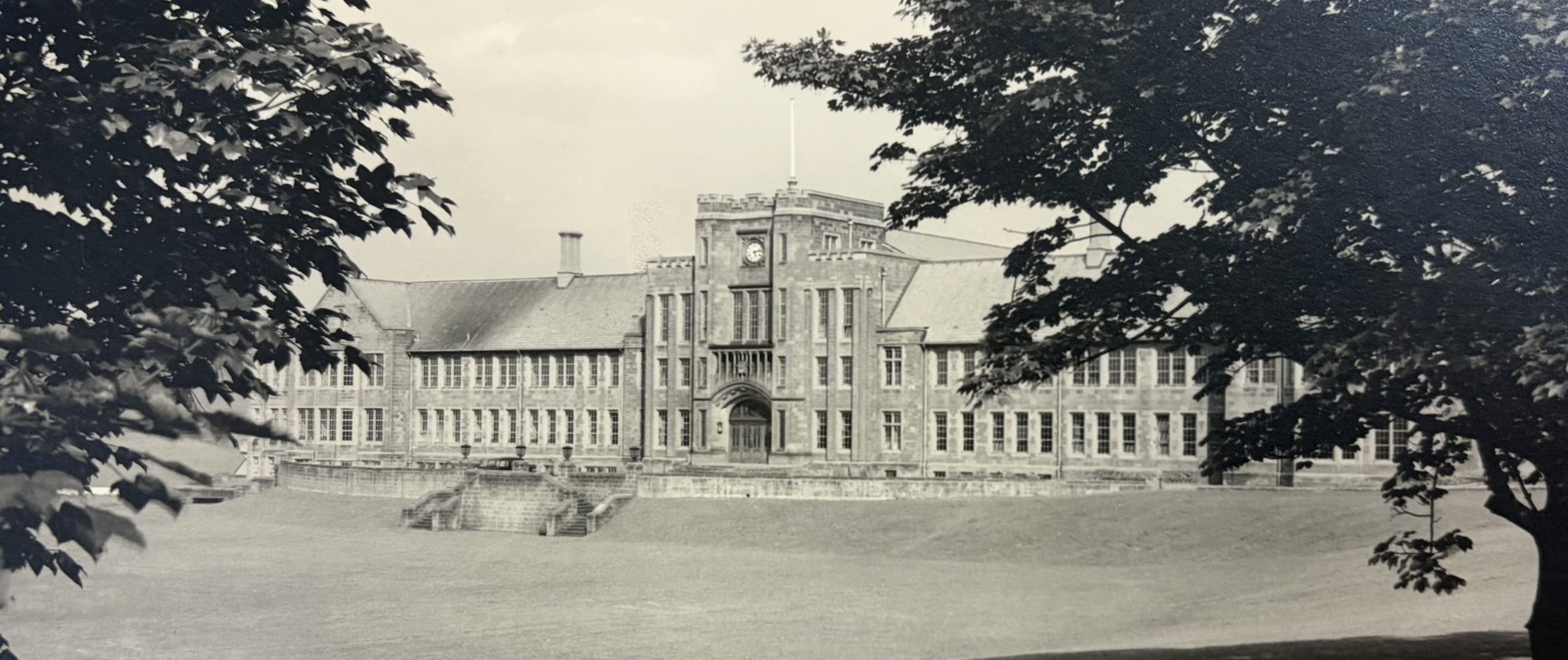
“Stone walls alone do not make a great school. Memories, ancient traditions, past struggles – the intangible things – these are what give a school its distinctive flavour and the breath of life.” – Yorkshire Illustrated, on the opening of the new building by Prince Philip in 1949.

Little is known about the earliest days of Bradford Grammar School, but it is known that the school was housed in the grounds of St Peter’s Church. The present church building dates from 1458 and has had the status of a Cathedral since 1919.

When the new school building was opened by HRH the Duke of Edinburgh in 1949, Yorkshire Illustrated published a major article about the school and its history. It was written by a resourceful young journalist named Trevor Lloyd‑Hughes. In later life, he became Prime Minister Harold Wilson’s Press Secretary, and was eventually knighted as Sir Trevor.

Lloyd‑Hughes speculated that, centuries before our written records, St Peter’s Church, like many others, was likely to have had its own small school.

Our earliest surviving documents date from 1548, when the government of Edward VI was taking control of many church properties under the Chantry Act of 1547, continuing a process begun by his father, Henry VIII, with the dissolution of the monasteries.

In 1548, the governors of the school were required to defend its endowment in the courts. As Arthur Busby records in his history of the school, one elderly citizen, Robert Sowden, drawing on his long memory, helped to persuade the court that “in ancient times certain estates had been left by pious founders for the living and sustentation of a schoolmaster teaching Grammar within the town of Bradford”.

In other words, the school’s endowment was quite separate from the funding of the church. The school won its case and kept the endowment. So BGS must have been founded and funded well before 1548, which likely takes it back into the 1400s, if not earlier. Bradford was a small town at the time, with a population of maybe 3,000. But that was enough to sustain the church and, plainly, also the school.

BGS was one of the first schools in the country to receive a charter from Charles II, soon after he was restored to the throne in 1660.

England passed through a decade of crisis during the Civil War of 1642–1651, and Bradford was hit hard. The town came under siege three times. On one occasion, the locals sheathed St Peter’s Church tower with sacks of wool to protect it from artillery fire.

In the late 1650s, the energetic governors of Bradford Grammar School began petitioning Parliament for a Charter. Their aim was to clarify the legal status of the school and to update some of the rules under which it operated.

They finally got what they wanted in 1662, shortly after the restoration of King Charles II. The Charter specified that fewer governors would be required, and that they would serve for life, or until they moved more than two miles from the parish.

With the Charter came a new legal name for the school: The Free Grammar School of Charles II in Bradford. This name has occasionally been used in places such as Founders’ Day programmes.

The governors could have chosen to rename the school The King Charles II Grammar School, but they decided not to do so. Instead, they preferred to continue using the name Bradford Grammar School!

BGS was re-organized and expanded during the 1870s, and William Hulton Keeling was appointed Headmaster. He would serve as head for an astonishing 45 years, dying still in office midway through WW1.

The City of Bradford entered the 1800s as a small town of around 6,000 people. It ended the century forty‑five times bigger, with a population of 279,000. Leeds and Manchester were larger to begin with, but nowhere grew as fast as Bradford, which quickly established itself as the centre of the global trade in wool.

In T. S. Eliot’s famous poem The Waste Land, published in 1922, he jokes about “a silk hat on a Bradford millionaire”. People talked about Bradford millionaires the way we talk about the billionaires of Silicon Valley. The decline of the old industries makes it easy to forget that Bradford was once one of the wealthiest cities in the world. It was also cosmopolitan.

So, when Parliament decided to pass the revolutionary Endowed Schools Act of 1869, the timing was perfect for BGS. The school had been in the doldrums in the earlier part of the century. One headmaster, with the wonderful name of Mr Slack, had to be fired, and local business leaders, including Sir Jacob Behrens, had actually set up another school for their boys, called the Bradford High School.

The 1869 Act set up a powerful Commission to revamp the old grammar schools, and it decided to begin with BGS as its very first project, quite possibly because W. E. Forster, who was functioning as Gladstone’s education minister, was Bradford’s MP.

As a result, by the middle of the 1870s BGS had a new, bigger, building, and a new headmaster, William Hulton Keeling. The fledgling High School had been combined with BGS, and the Commission had also decided to spin off the Bradford Girls’ Grammar School (BGGS), initially funded by part of the BGS endowment, as education for girls was high on its list of priorities. As a result, BGGS still celebrates the Charter of Charles II and shares Hoc Age as its motto.

Keeling lead BGS into the 20th century as a larger school (360 boys in 1883, to 500 in 1903, and 580 in 1912), and one with high academic standards. Success at “Higher Certificate” level (the A‑levels of the day) placed the school among the top in the country.

In 1912, ten boys were awarded scholarships at Oxford or Cambridge. Bradford’s industrial leaders generously added to the school’s resources, funding “Leaving Exhibitions” to support boys through university – in days well before student grants and loans!

In that same year, 165 boys held City Council Scholarships covering all fees and charges for books, as well as 10 West Riding Scholarships and 60 Governors’ Scholarships, which covered half their school fees.

Meanwhile, interest in games was growing, with “houses” established to encourage intramural matches, and much competition against other schools. In 1899, long before the purchase of the Clock House estate where the new school would be built in the 1930s, BGS bought the Frizinghall playing fields and built the sports pavilion that was only recently replaced. Other activities flourished too. The school archive still contains the Debating Society Minutes from those days!

Graham, a keen mountaineer and also a pacifist Quaker, was Headmaster during the tumultuous years of WW2, the beginning of the “direct grant” initiative, and the move into the new school building in 1949.

Toward the end of WW2, as the nation longed for post-war peace and opportunity, Winston Churchill’s coalition government passed the 1944 Education Act. The Act sought to widen access to high‑quality secondary education for bright children from lower‑income households.

Their brilliant solution was a big expansion of the “direct grant” system, which provided state scholarships to enable pupils to attend leading independent schools. As we have seen, the City of Bradford was already funding the fees of many boys at the school.

The new policy encouraged local education authorities to continue supporting pupils in this way, while contributing additional government funding. Alongside BGS, Bradford Girls’ Grammar School and St Joseph’s also took part in the scheme.

For the next thirty years, the brightest boys and girls were able to attend these independent schools, irrespective of their parents’ income.

In 1974, the incoming Labour government decided to wind down the direct grant scheme, to focus on spreading “comprehensive” education. Schools such as BGS were offered the choice of joining the state system as comprehensive schools or continuing independently without government scholarship funding.

The governors of Bradford Grammar School decided to carry on without the funding and the story of the past fifty years shows what a good decision that proved to be!

David Smith served as Headmaster for 22 years, leading BGS through a challenging time as the “direct grant” scholarships wound down – and new building projects were developed! He emerged as a major figure in the wider world of education, serving as chair of the Headmasters’ Conference and being awarded the OBE.

One major change was the move to co‑education, first in the Sixth Form in 1984, and then fully across the school from 1999.  Another has been the merger of Moorfield School, Ilkley and BGS to form the Bradford Grammar School Foundation, a significant development achieved during the tenure of the current headmaster, Simon Hinchliffe to secure the future of independent education in the region.

There has also been a series of major building projects, including the Kenneth Robinson Building, the Clarkson Library, improved sports facilities, the Sixth Form Centre, the Hockney Theatre, and the Early Years hub. These developments reflect the school’s long‑standing focus on excellence in every aspect of school life.

Generous benefactors have continued to support these projects, many of them Old Bradfordians, maintaining a tradition that stretches back to those who first endowed land to establish the school in the 1500s and before. The leaders of Bradford’s industrial heyday in the extraordinary 1800s, like Sir Jacob Behrens and Sir Titus Salt, who powered the school’s expansion and, in the years from Keeling’s headmastership onwards, enabled its emergence as one of the leading schools of the United Kingdom.

Further reading on the history of Bradford Grammar School is available in the following scans of original books held in the archive:

Bradford Grammar School, Past and Present, 1662-1912, the Rev W H Keeling, former Headmaster of the School

Origin and History of the Bradford Grammar School from its formation to 1882, Part 1, W Claridge MA, former Headmaster of the School

Origin and History of the Bradford Grammar School from its formation to 1882, Part 2, W Claridge MA, former Headmaster of the School

A further book, Haec Egimus – All This We Did, by David Moore (OB 1952 -1962), covers the history of BGS from 1949-1963.

Bradford Grammar School Crest

Reception

FIND OUT MORE

Reception is a lovely environment that carefully balances both teacher and pupil-initiated learning.

FIND OUT MORE

Junior School

FIND OUT MORE

Our creative approach to learning allows children to develop into unique individuals

FIND OUT MORE

Senior School

FIND OUT MORE

An education at BGS offers inspiration to enrich the mind, body and spirit, which fundamentally changes lives for the better

FIND OUT MORE

Sixth Form

FIND OUT MORE

Our innovative Sixth Form lays the foundations for creative and inspiring excellence

FIND OUT MORE