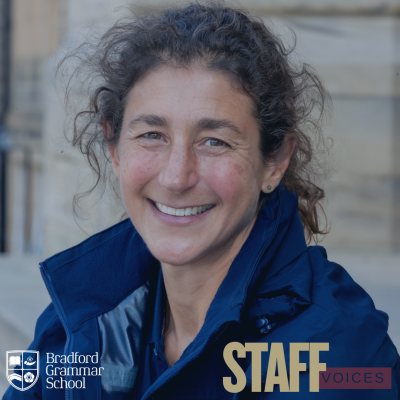
As Head of Academic PE, Heidi Hinchliffe brings a wealth of experience as a teacher, coach and former top-tier university athlete. Here, she reflects on the rigour of PE as an academic subject, the outstanding achievements of BGS students and the collaboration between academic staff and specialist coaches that sets the school apart.
When people ask me why I teach PE, I always go back to school. I can picture the teachers who inspired me — the ones who noticed my enthusiasm and gave me the encouragement to push further. They didn’t just teach me to play netball, hockey or athletics; they taught me what commitment and resilience looked like. I think that’s why I’m so passionate about the subject now. I know the difference it made to me, and I want my students to feel that same spark.
I carried that love of sport into university, studying Sport and Recreation Studies at Birmingham. I wasn’t just in lectures — I was on the court and the pitches. I played three first-team sports, representing the university in volleyball, hockey and rugby union, and by the time I graduated I had not only earned a degree but also the Vice Chancellor’s Award for the outstanding graduate of the year. Those years shaped me. They showed me how sport demands more than physical talent. It’s about organisation, teamwork and knowing when to lead and when to support.
After my PGCE, I started teaching in Birmingham and then spent 14 years as Head of Girls’ PE at Wolverhampton Grammar. Following a career break to focus on my young children, I returned to teaching in Yorkshire, working across a variety of schools before joining BGS in 2024.
My focus here is academic PE – GCSE and A Level courses that can be underestimated by those outside the subject. Too often people think PE is just about playing sport, but the reality couldn’t be further from the truth. In the classroom, our students study anatomy and physiology in depth, explore psychology and the mental skills needed for peak performance, examine biomechanics, and investigate sport in its social and cultural context – from the violent, male-dominated games of pre-industrial Britain to modern-day issues of race, gender, and technology.
At A Level, students must combine the study of theory with their own performance in a chosen sport, often competing at county or even national level. It’s a demanding combination. That’s why I always emphasise to parents and students alike: PE is not a soft option. It is rigorous, respected and increasingly valued by universities.
The Academic PE department is small but highly experienced, allowing us to offer a personalised approach, especially at A Level where smaller class sizes mean students benefit from targeted support and strong teacher-student relationships.
The results speak for themselves. In 2025, five of our students sat A Level PE. Between them they achieved three A*s and two As and four of them went on to study sport-related degrees at leading universities including Loughborough. At GCSE, we consistently see many students achieving grades 7–9, reflecting the hard work and talent in the department.
One of the things I love about BGS is the way the academic PE team works alongside our exceptional coaching staff. We’re lucky- we have an extensive team of highly qualified specialist sports coaches, assistant coaches, sports graduates and a number of expert teaching staff all of whom bring professional-level expertise to the students they train. Their coaching complements what we do in the classroom. When I’m teaching the physiology of recovery, for instance, students can see it applied directly in their training sessions. Our Athletic Development Programme, led by Ben Nabozny, is another strength. In the gym, students gain practical experience of how to train properly, avoid injury and build the strength that underpins performance.
That structured pathway means we can spot talent early, even in the Junior School, and nurture it all the way through to Sixth Form. By the time students are sitting GCSE or A Level PE, they already understand what it means to set goals, track progress and reflect critically on their development.
One of my favourite parts of the job is helping athletes make those connections between theory and practice. It might be a hockey player realising that the science of energy systems explains her sprinting performance, or a tennis player recognising how sports psychology sheds light on his pre-match nerves. When those lightbulb moments happen, students begin to see sport not just as something they do but as something they understand.
The sports students who thrive are often the busiest. Many are musicians, actors, debaters and high-achieving scholars as well as athletes. And that’s the point… they learn to manage their time, balance competing demands and still perform at a high level. These are life skills, not just exam skills.
I also bring a family perspective to my role. As Simon’s (Headmaster) wife and a parent of two children at BGS, I already knew the school well before joining the staff. Our children are thriving here, and I believe this dual view as teacher and parent gives me a unique insight that helps me support students, particularly in a pastoral context.
For me, BGS is about more than grades or medals. Don’t get me wrong — I’m incredibly proud of our results and the achievements of our students at regional and national level. But what excites me most is the way sport here shapes people. It builds resilience. It creates friendships that last. It teaches young people to fail and to come back stronger.
As a teacher, I feel privileged to play a part in that journey. And as a parent, I see my own children benefitting from this special environment: a school that celebrates breadth, pushes for excellence and values community. It’s exactly the kind of education I would have thrived on myself and it’s a joy to be here now, giving today’s students the opportunities that once inspired me.
“As a teacher, I feel privileged to play a part in that journey. And as a parent, I see my own children benefitting from this special environment: a school that celebrates breadth, pushes for excellence and values community. It’s exactly the kind of education I would have thrived on myself and it’s a joy to be here now, giving today’s students the opportunities that once inspired me.”