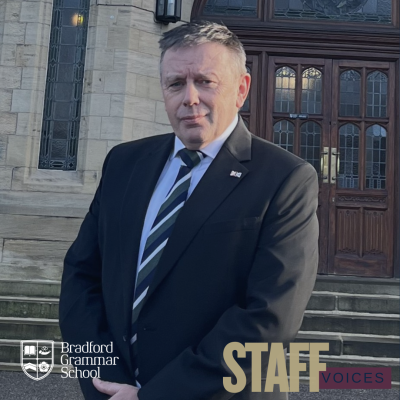
From managing a 30-acre site to driving sustainability initiatives and delivering major redevelopment projects, Estates Manager Ian Clint plays a vital role in the daily life of Bradford Grammar School. Here, he shares his insight into the unseen work that keeps the school operating seamlessly.
Keeping a school running smoothly is something most people rarely think about. They arrive to warm classrooms, working facilities, well-kept grounds and events that unfold without difficulty. At Bradford Grammar School, delivering that consistency across 30 acres, dozens of buildings and thousands of daily interactions is the responsibility of the estates team.
During my 12 years at BGS, I’ve come to understand that the best estates work is often invisible. When everything works, nobody notices — but it takes careful planning, problem-solving and daily attention to detail to keep the school operating as it should.
I joined BGS in 2014, bringing with me 24 years of experience in engineering and building services within the newspaper industry. I trained as a chartered engineer and spent most of my career with Newsquest, a major UK regional newspaper group, working across large, complex sites including The Press and The Northern Echo in York and, later, Glasgow, the company’s biggest printing facility. Newspapers taught me two things that still define how I work today: systems matter, and deadlines are non-negotiable. You can’t miss a print run — just as you can’t miss the first day of term.
That industrial background might seem a world away from education, but the crossover is substantial. Understanding how buildings function, how energy is consumed, how people work most effectively within a system — and how to make all of that more efficient — is fundamental to running a modern school estate. When I arrived at BGS, those efficiencies weren’t fully embedded. My role was to change that, carefully and responsibly, while never losing sight of the fact that this is a school, not a factory.
The estates’ function here is extensive, with a team of around 47 people. That includes 20 cleaners, led by a cleaning manager and supervisors; a dedicated in-house maintenance team with our own electrician and plumber; a grounds team responsible for our sprawling site; and caretakers who open the school early each morning and often don’t leave until late in the evening.
The team takes enormous pride in the environment they help create. When the Price Hall is ready for a major event, when corridors are spotless or when visitors comment on the condition of the grounds as they arrive, that reflects hours of care, preparation and consistency. The standards are high, and they have to be — because the condition of a school says a great deal about its culture and its values.
No two days are ever the same. There are structured processes — particularly around health and safety — but the environment is inherently dynamic. A day might involve strategic planning for governors, managing budgets and contractors or dealing with something immediate and unpredictable. On the morning of a nativity play, for example, I found myself in the car park helping manage traffic because we were short-staffed and the site was unusually busy. At moments like that, everyone pitches in.
Alongside the day-to-day running of the estate, there are major projects that bring their own challenges. Schools operate to immovable deadlines. Pupils return when they return, and everything must be ready. That means large-scale works are usually confined to narrow windows, particularly during the summer break.
One of the most complex and rewarding projects I’ve overseen is the redevelopment of the Sixth Form Centre. Completed over ten weeks, it involved a complete renewal of the building fabric, installation of underfloor heating, the introduction of a café space, improved study areas and significant mechanical and environmental upgrades. Intelligent ventilation systems now respond automatically to temperature and CO₂ levels, opening windows automatically when fresh air is needed. The result is a space that’s no longer prone to overheating and instead provides a far more comfortable and effective learning environment. It required careful planning, close collaboration with academic staff, strict budget control and absolute precision on delivery.
Lettings are another important part of how we manage the estate. While they often sit quietly alongside the school day, they play a significant role in ensuring our facilities are used effectively and responsibly. Our sports facilities, swimming pool and pitches are in constant demand, and the Price Hall has hosted major external events, including the Bradford 2025 Turner Prize Awards. Occasions like that demonstrate how careful stewardship of the estate can support the wider community while safeguarding the long-term future of the school.
Sustainability has also been a major focus of my time here. Every light across the school is now LED — a change implemented gradually, supported by data and clear benchmarking. Three years ago, we installed solar photovoltaic panels that now provide around 30 per cent of the school’s electricity. We have been zero to landfill since 2017, with fully segregated waste streams across the site. These practices were standard in industrial environments, but they were far from common in schools when we introduced them.
Looking ahead, the challenge is how we use energy more intelligently. During the summer holidays, when demand is lower, we generate solar power that we can’t fully use and export it back to the grid. My focus now is on constant demands — particularly the swimming pool — and on reducing our reliance on gas through a combination of additional PV capacity and air source heat pumps. These proposals go through the governors’ resources committee, where long-term value and sustainability are taken seriously.
What has kept me at BGS for over a decade isn’t just the complexity of the role or the satisfaction of solving problems. It’s the culture. After many years in corporate environments, I’ve found this is a place where people are genuinely trusted and valued, where training and development are actively supported and where the quiet, behind-the-scenes work that keeps the school running smoothly is understood and appreciated.
The estates team may rarely be in the spotlight, but everything the school does depends on their work. From unlocking the doors each morning to ensuring the site is safe, welcoming and ready for whatever the day brings, I like to think we provide the foundation on which the life of the school is built.
“The estates team may rarely be in the spotlight, but everything the school does depends on their work. From unlocking the doors each morning to ensuring the site is safe, welcoming and ready for whatever the day brings, I like to think we provide the foundation on which the life of the school is built.”