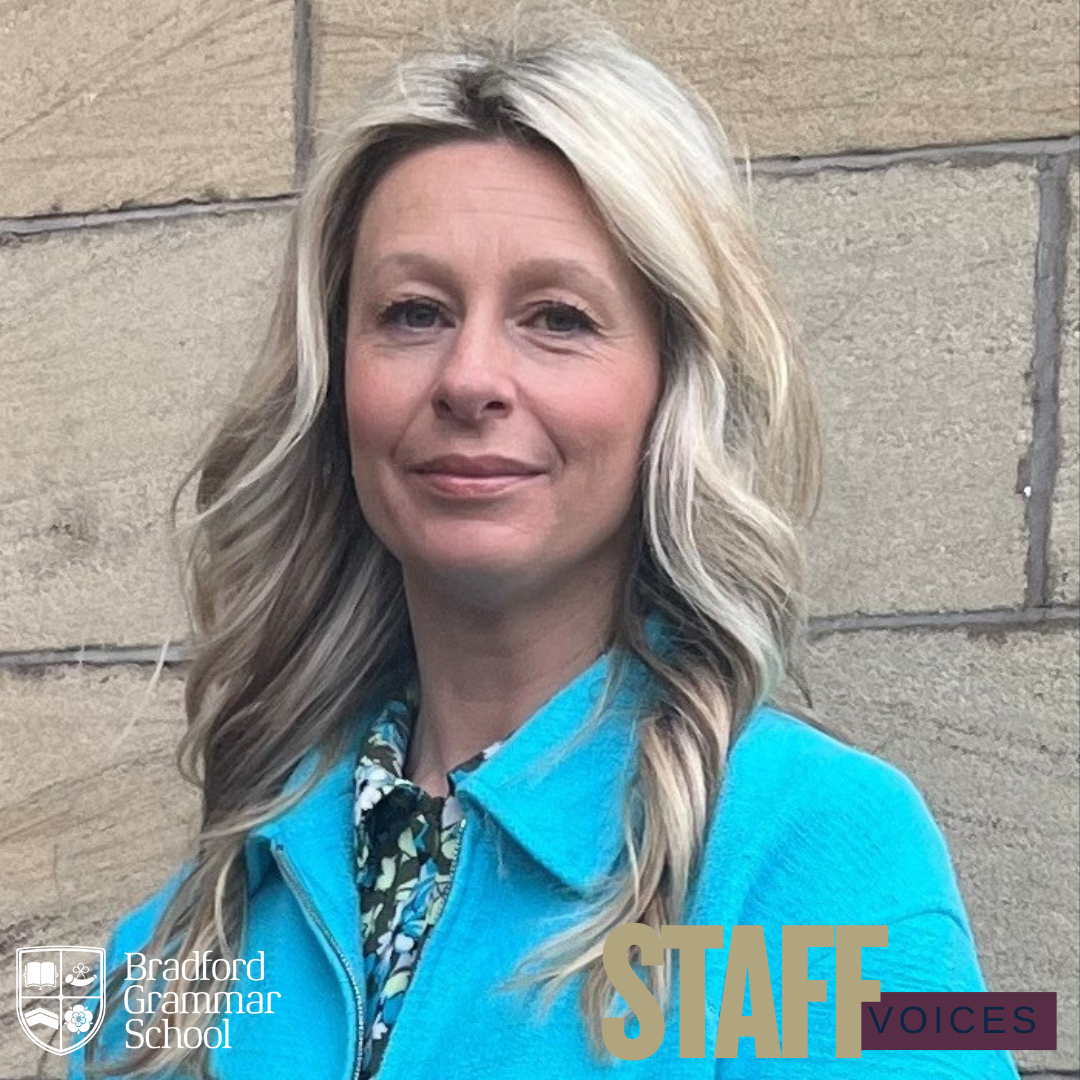
Angela McOwen, Head of Politics, Head of Sixth Form Enrichment and EPQ Coordinator at Bradford Grammar School, shares her passion for sparking curiosity, critical thinking and independence in students.
When people ask me what makes the Politics Department at BGS so successful, my answer is simple: it is led by specialists who love the subject and live it every day. Politics here isn’t a minority subject; it’s at the heart of the Sixth Form curriculum. I teach A Level politics full-time and I’m supported by two excellent colleagues, Mr Jones and Mr Ali. Between us, we ensure students are exposed to the big ideas, controversies and debates that make the study of politics so stimulating.
What sets us apart is the breadth and relevance of the course. Since 2017, we’ve followed a specification that includes UK politics, US politics and political ideas. The combination means our students not only analyse Westminster and Whitehall but also grapple with Supreme Court rulings in the US, the role of the presidency and the main ideologies that underpin political thought in the UK and US. At a time when young people’s social media feeds are filled with commentary on American politics – from Trump-era controversies to Supreme Court decisions – this is an area they arrive curious about. That curiosity is our springboard. We equip them with the literacy to move from the clickbait headline to deeper research, to weigh evidence and to reach their own reasoned conclusions.
Closer to home, engagement with UK politics surged after Brexit. Our students now have a sharper sense that political decisions shape their lives and they want to understand the various factors that influence those decisions and how they are made in depth. That sense of agency – of politics being for them and not just something happening in Westminster – has transformed classroom debate.
My own passion for politics was sparked at school age. I was 14, studying economics at GCSE in my state comprehensive in Greater Manchester, when I realised it was the political decisions behind the economics that really fascinated me. Studying A-level Politics with a teacher who loved the subject confirmed it for me. I went on to read Politics and Social and Governmental Policy at the University of Manchester, tried the corporate world and quickly realised I wanted a career that enabled me to remain deeply connected to academic political science. Encouraged by a neighbour – herself a teacher – I retrained, took a PGCE in Politics at Manchester Metropolitan and joined BGS in 2006.
But education here goes far beyond subject teaching. As Head of Sixth Form Enrichment, I oversee a programme that every Year 12 pupil takes part in. The idea is to give them a year of exploration beyond their A-level choices, developing skills and perspectives that will stay with them for life. Some pursue examined courses such as Beginners’ Japanese, the Pool Lifeguarding Qualification or the Sports Leaders Qualification. Others choose non-examined options like International Relations, Philosophy or Photography. It’s a chance to step outside their usual subjects, discover new interests and gain qualifications or skills that broaden their outlook.
For those learners keen to embrace academic autonomy, enrichment can also mean the Extended Project Qualification (EPQ), which I have had the privilege of coordinating for over a decade. The EPQ allows Year 12 students to design and carry out an independent research project on a topic of their choice – recent examples have explored questions such as whether professional wrestling should be considered a sport, or whether the use of electro-convulsive therapy is consistent with principles of biomedical ethics. It’s very different from classroom learning: teachers step back into the role of facilitators, while students drive the process. They select their research question, justify its academic value, manage deadlines and present their findings. It’s an enormous challenge, and not every student feels ready for it, but those who do take it on develop independence and scholarly skills that are recognised far beyond BGS.
Universities – from Oxbridge to the Russell Group and beyond – value the EPQ because it mirrors the process of writing a dissertation. Our students learn about academic integrity, how to reference sources properly and how to work with databases such as JSTOR. They practise presenting their ideas to an audience. Most importantly, they prove to themselves that they can carry through a substantial, original piece of work from start to finish. This year’s outcomes reflected that hard work and commitment: 14 students achieved an A*, 13 gained an A and four a B. It’s an exceptional set of results and a testament to how carefully we have refined the transition process, ensuring that by the time students embark on their EPQ, they know exactly what is expected of them and are ready to rise to the challenge.
Almost twenty years on from when I first joined BGS, I’m proud to see Politics thriving, enrichment flourishing and the EPQ producing remarkable outcomes. All three strands share a common goal: to inspire curiosity, independence and a love of learning. That is what I believe education should be about – preparing young people not just to pass exams, but to think critically, to question confidently and to shape the world around them.
“Almost twenty years on from when I first joined BGS, I’m proud to see Politics thriving, enrichment flourishing and the EPQ producing remarkable outcomes. All three strands share a common goal: to inspire curiosity, independence and a love of learning”