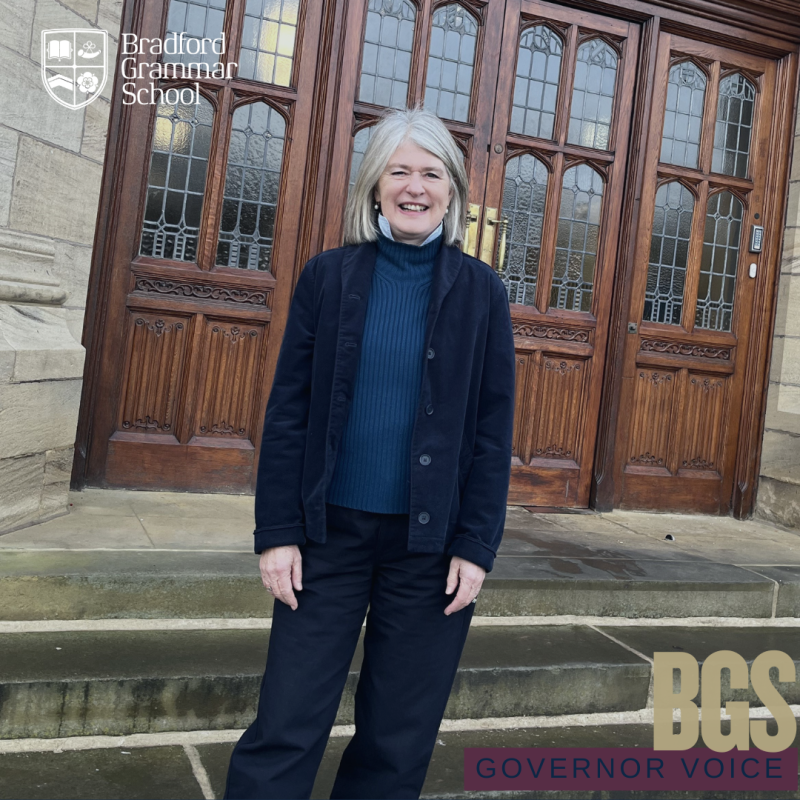
Jane Disley brings decades of educational leadership to her role as a Governor at Bradford Grammar School. In this first Governor Voice piece, she shares insight into the strategic role governors play, the responsibilities behind the scenes and the perspective her career in education brings to shaping the school’s future.
People often assume that governors sit at a distance from the day-to-day life of a school. The reality is very different. Governance is about responsibility, challenge and support, but above all, it’s about ensuring the long-term future of the school and the education it provides. That responsibility is something I take extremely seriously, shaped by my entire professional life in education.
My connection with Bradford Grammar School (BGS) began long before I joined the governing body. I spent my career as a teacher and Head, working across primary and secondary education in both the state and independent sectors, as well as overseas, including headships at Moorfield School and Richmond House School. Throughout that time, BGS was a school I respected enormously. It maintained strong academic standards without compromising its integrity. As a Head, I saw many schools that would lower entry expectations simply to increase numbers. BGS never did that. It remained selective, but it also listened carefully to individual circumstances and potential. That balance matters.
After retiring in 2016 following a long career, I had not intended to return to work. However, in 2019, I was asked by the Headmaster, Dr Simon Hinchliffe, to step in as Interim Head of the Junior School. I initially agreed to help for two terms while the school navigated leadership change, but that was extended with the arrival of COVID-19 and the significant challenges it presented. That experience gave me a close view of the school’s strengths, the pressures it faced and, importantly, its culture. A little later, I was invited to join the governing body. For me, it felt like a natural progression and an opportunity to contribute to a school I had long admired.
The role of a governor is often misunderstood. The governing body does not run the school on a daily basis – that is the role of the Head and the Senior Leadership Team. Our responsibility, in alignment with the headmaster, is strategic. We ensure that the school has clear direction, strong oversight and the right structures in place to allow staff to deliver an exceptional education.
At BGS, the governing body is made up of individuals with a wide range of professional expertise, including finance, estates, legal, academic and business backgrounds. We work collectively through committees as well as full board meetings. I chair the Compliance Committee, which focuses on the systems that underpin the school. This includes areas such as health and safety, recruitment procedures and anti-bullying frameworks. These may not always be visible to parents or students, but they are fundamental. High-quality education cannot exist without safe, well-run systems behind it.
I also sit on the Education Committee, which focuses more directly on academic provision. That involves reviewing curriculum development, monitoring academic performance and asking difficult but necessary questions. If results or performance data show that one subject is thriving while another is not performing as strongly, governors need to understand why. Our role is not to interfere in teaching, but to ensure the school continually reflects, evolves and improves.
My background as a classroom teacher and school leader provides a perspective that is slightly different from many of my fellow governors. It allows me to act, at times, as a translator between governance and classroom practice. Education has its own language and complexities, and part of my role is ensuring that decisions made at board level are grounded in educational reality.
One area where this perspective proved valuable was during the development of the school’s early years provision. Expanding the school to include Reception and Year One was a significant strategic decision. It required not only financial and estate expertise but also detailed understanding of how young children learn and what environments they need to thrive. Being involved in that project from concept to completion was particularly rewarding because it demonstrates how governance can shape the long-term educational journey of students.
Governance is not without challenge. A strong governing body must be collegiate but also willing to question. We regularly debate issues robustly and honestly. Good governance requires individuals who are prepared to challenge assumptions, defend their reasoning and ultimately make decisions that serve the school’s best interests, even when those decisions are difficult.
BGS also faces challenges that reflect the wider educational landscape. Independent schools operate within a complex financial and social environment, particularly in a city like Bradford. One of our most important priorities is ensuring the school remains accessible to talented students regardless of financial background. The Assisted Places scheme is central to that commitment. Potential and ambition are not determined by family income, and supporting students who would otherwise be unable to access this education enriches the entire school community. Diversity of experience strengthens education for everyone.
Financial stewardship is another critical responsibility. Investment decisions must always focus on educational impact rather than prestige. Our responsibility is to ensure resources support teaching, learning and student development first and foremost.
Ultimately, governance exists to protect and nurture the ethos of BGS. Academic excellence is essential, but education is about far more than examination success. Our responsibility is to ensure students develop confidence and resilience, preparing them for a future that none of us can fully predict. The world has changed dramatically during my own lifetime, and schools must prepare young people not simply to pass exams, but to think independently and adapt to change.
What makes BGS distinctive is its ability to combine academic rigour with breadth and individuality. It’s a school that allows students to find their strengths, whether they are scientists, artists, musicians or future entrepreneurs. Governors play a crucial role in ensuring that environment continues to flourish.
For me personally, serving as a governor is both a privilege and a responsibility. It allows me to continue contributing to education in a meaningful way, supporting staff, challenging appropriately and helping ensure that BGS remains a place where young people can discover who they are and what they might become.
Interested in a BGS Education for your child. Here you will find more information on applying for a place and our assisted place awards.
“For me personally, serving as a governor is both a privilege and a responsibility. It allows me to continue contributing to education in a meaningful way, supporting staff, challenging appropriately and helping ensure that BGS remains a place where young people can discover who they are and what they might become.”