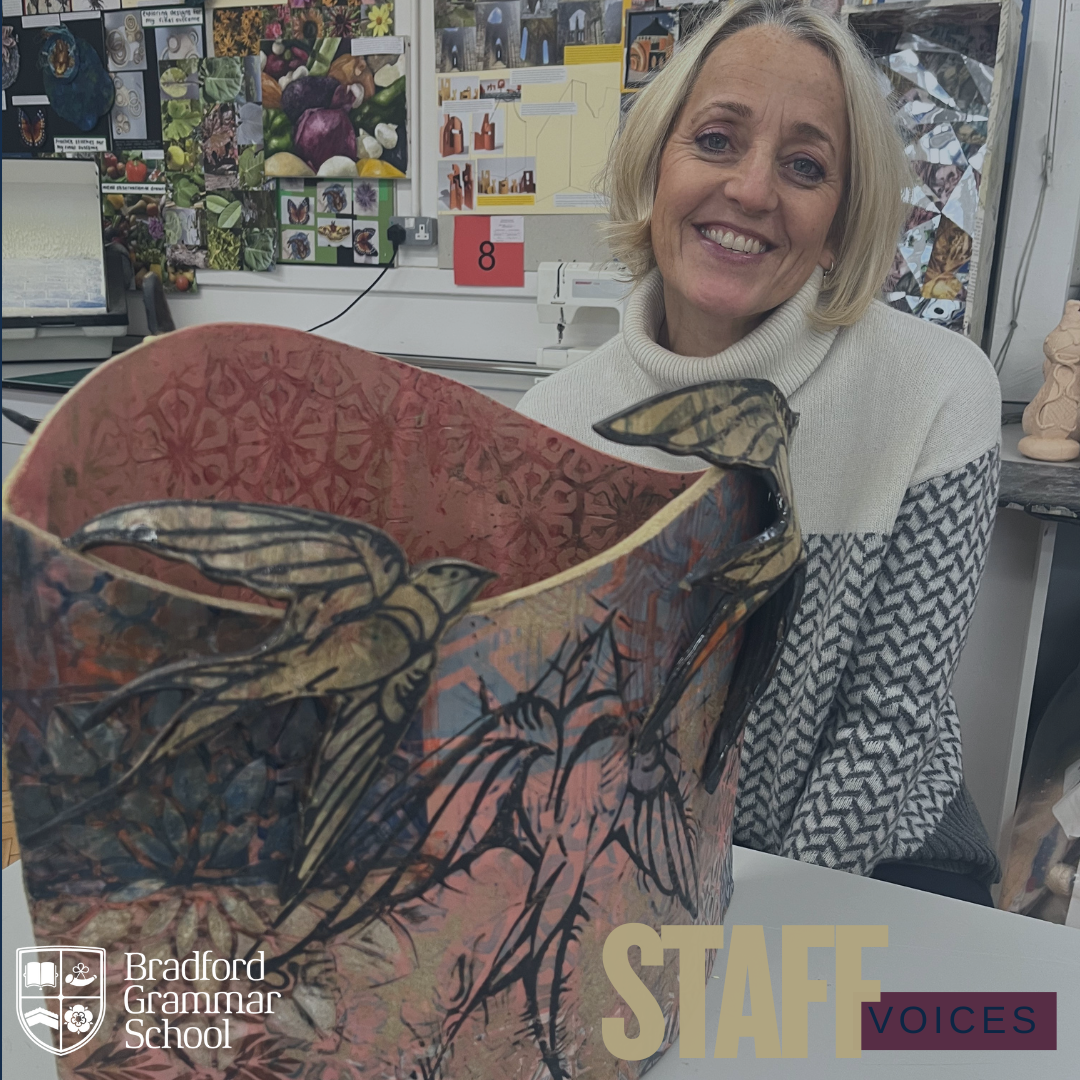
Here, she reflects on her own artistic journey — from glassblowing studios in the US to the classrooms of BGS — and the joy of watching young artists discover who they are.
The art room should be a place where ideas arrive uninvited, where mistakes are not only expected but encouraged and where you can lose track of time because you’re absorbed in making something that didn’t exist an hour before. That sense of freedom shaped my childhood, and I’m determined to protect it for every student who walks into the Bradford Grammar School Art Department.
Art was always my safe place. School wasn’t straightforward for me; much later, I learned I was dyslexic, but at the time I simply thought I wasn’t very academic. Art was where I felt bright, capable and seen. I had a brilliant art department at my school and three teachers I adored. I model much of my teaching on what they gave me: genuine encouragement, room to explore and the belief that there’s no single ‘right’ way to be creative.
After school, I went to Huddersfield Art College for my foundation course and tried everything — fine art, textiles, DT, painting, ceramics — and loved the freedom of it. For a while, I was sure I’d be a textile artist, until I realised I didn’t quite fit that world. Instead, almost instinctively, I found glassblowing. It was the hardest, hottest, most physically demanding art form I’d ever encountered, and I loved it.
I trained in Wolverhampton and spent a semester at Alfred University in the United States, often working through the night in the glass studios. Later, I became an apprentice at Blowzone in Stourbridge, learning from incredible makers and selling my own pieces at festivals. Eventually, I worked with Okra and Moorcroft. Glass taught me the most important lesson I now bring into the classroom: you cannot be precious when you work with molten glass. You experiment, you adapt and sometimes you start again.
Teaching wasn’t always part of the plan, but after years away, I felt the pull of Yorkshire again. Opening my own studio wasn’t feasible, so I applied for my PGCE. Near the end of the course, a maternity cover post at BGS came up. I threw myself into the interview, got the job and I’ve never looked back.
I’ve now been at BGS for 24 years and Head of Art since 2019. I didn’t anticipate staying this long, but this school gets under your skin. My own sons came through BGS, and I believe deeply in what the school offers — academically, socially and creatively.
The art department today is worlds away from the one I walked into. Back then, it was very traditional: lots of ceramics, painting and drawing, occasional lino printing. Over time, as staff have changed and the school has evolved, we’ve embraced new materials, modern techniques and technology, and a much more experimental ethos.
Now, the best way to describe BGS Art is simple: there are no boundaries.
At Key Stage 3, students build strong foundations — drawing, painting, printmaking, ceramics, sculpture, textiles and digital media. But the real explosion happens at GCSE and A Level. Every student becomes a project in their own right. We aren’t delivering one lesson to a class; we’re guiding each student on their own creative journey. It’s exhilarating, exhausting and endlessly rewarding.
What makes our department special is that we never impose a single “house style.” Students bring their own ideas and identity, and our job is to help them shape those into meaningful work. Some gravitate towards painting or textiles, others ceramics or 3D work, and many mix traditional techniques with digital processes like Photoshop or laser cutting.
I work with a strong team. Because we’re all practising artists — painters, printers, illustrators, ceramicists — we understand what it feels like to sit in that electric space of making something new. We’re constantly in and out of each other’s classrooms, sharing ideas, recommending artists and celebrating student breakthroughs. A thriving art department has to be collaborative. Creativity doesn’t flourish in isolation.
The school understands that, too. Although BGS is known for academic excellence, the arts aren’t overshadowed. Walk through the corridors and you’ll find student work everywhere — a visible and valued presence. One highlight is our biennial exhibition at Salts Mill, where we showcase around 300 pieces of student work. We’ve also introduced Artist of the Month and Artist of the Year, celebrated with a coveted enamel badge students wear with pride.
We take students out into the world as well — to the Yorkshire Sculpture Park, galleries, workshops and, most recently, with 28 students, to Barcelona. And this year we have something extraordinary on our doorstep: the Turner Prize exhibition, hosted in Bradford during the city’s year as UK City of Culture. BGS will even host the announcement ceremony for the 2025 Turner Prize winner. That connection shows our young artists that art is alive, relevant, challenging — and happening right here.
BGS also has its own place in art history. David Hockney, one of Britain’s most celebrated artists, is an Old Bradfordian. Many students know his work long before they know he once sat in a classroom just like theirs.
If you ask what I love most about my job, it’s simple: watching students surprise themselves. The quiet ones who suddenly take a creative risk. The highly academic students who realise they need a space where perfection doesn’t matter. The reluctant drawers who discover they love sculpture.
I’m proud of what we do. Proud of my team. Proud of our students. Proud that in a school filled with brilliance and ambition, there is still room for mess, experimentation and creative chaos. That freedom shaped my life, and I hope I’m passing a little of it on.
“I’m proud of what we do. Proud of my team. Proud of our students. Proud that in a school filled with brilliance and ambition, there is still room for mess, experimentation and creative chaos. That freedom shaped my life, and I hope I’m passing a little of it on.”